
Free Diagnostic Gives Finance Teams a Reading on Organizational Stability Before 2027 Budgets Are Approved
The Drift Tax Diagnostic, from Jim Rembach's Amazon Best Seller, scores how much of an organization's stability is held
Press Release Disclaimer: This is a press release distributed through the XPR Media network. It has not been independently verified by our newsroom.
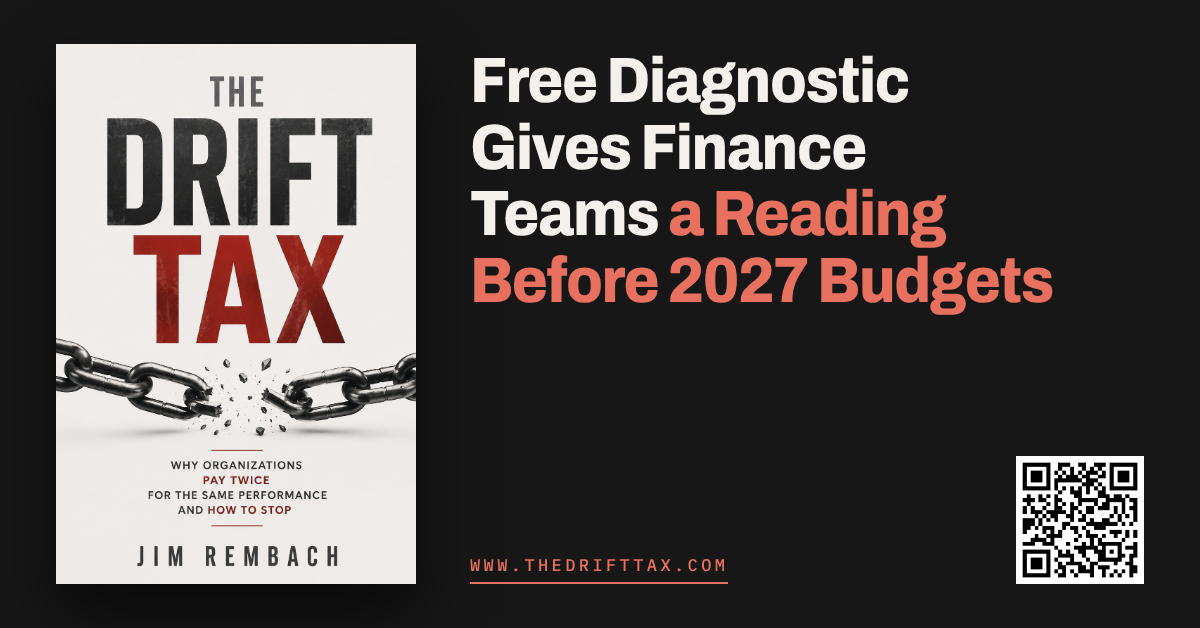

The Drift Tax Diagnostic, from Jim Rembach’s Amazon Best Seller, scores how much of an organization’s stability is held by design rather than by effort.
GREENSBORO, NC, UNITED STATES, November 10, 2026 /EINPresswire.com/ — The Drift Tax Diagnostic produces an Architecture Score out of 100 from ten statements about how an organization runs on an ordinary Tuesday. The free assessment comes from The Drift Tax: Why Organizations Pay Twice for the Same Performance and How to Stop, by Jim Rembach, Executive Director of the Leadership Execution Institute. The book, published by LEI Press on October 12, 2026, is an Amazon Best Seller in two business and management categories.
The book argues that the Drift Tax collects its largest payment at the moment of the fix, and that annual planning in November is when those fixes are approved. The diagnostic is built to be taken before those decisions are final.
What does the diagnostic measure?
Each statement is scored from 0 to 4 based on how a behavior is held, not whether it appears. A 4 means a named system holds it even when people are busy, stressed, or gone. A 0 means no real example exists. The total is multiplied by 2.5 to produce the Architecture Score.
The ten statements pair into five dimensions: Standards Protection, Signal Visibility, Compounding Climate, Ownership and Accounting, and In-Flow Reinforcement. The online version returns an Exposure Report with a reading for each dimension and the organization’s lowest-scoring area.
What do the scores mean?
The book sets four ranges. A score from 30 to 54, labeled Paying in Fragments, is described as the most common reading: pockets of stability held up by individual managers, with the cost collected everywhere else. Scores from 0 to 29 are labeled Compounding, Unmanaged. Scores from 55 to 79 indicate Reinforced Pockets, and 80 to 100 indicate Partial Architecture.
Why take it before budgets are approved?
Statement seven asks whether an organization can tell which people-spending buys new capability and which buys back capability it already paid for once. Chapter 6 of the book follows how annual planning renews programs that repair the same problem each year under new names, a section Rembach titles “The Tax Collector Loves November.”
How should an executive team use the results?
Rembach recommends that colleagues take the diagnostic individually and compare readings. “Where the numbers disagree is where the conversation is,” he writes. The lowest-scoring dimension, which the book calls the focus gap, points to the chapter instrument to run first. He also cautions that a score is a starting point: “A diagnostic is a reading, not a repair.”
What has been said about the book?
Ron Friedman, Ph.D., bestselling author of Superteams and The Best Place to Work, wrote of the book: “Building a high-performing team is hard. Keeping it high-performing is even harder. In The Drift Tax, Jim Rembach shows leaders how to create an environment that reinforces the right behaviors day after day in ways that promote sustained excellence. Smart, timely, and immediately useful.”
The diagnostic is free at diagnostic.thedrifttax.com. The Drift Tax is available in hardcover, paperback, ebook, and audiobook through Amazon and major retailers. Excerpts and details are at www.thedrifttax.com.
About The Drift Tax
The Drift Tax: Why Organizations Pay Twice for the Same Performance and How to Stop, by Jim Rembach, is published by LEI Press and was released October 12, 2026, in hardcover (ISBN 979-8-90589-141-0), paperback (ISBN 979-8-90589-140-3), ebook (ISBN 979-8-90589-139-7), and audiobook (ISBN 979-8-90589-142-7). It is about the hidden taxes organizations pay when their people drift, causing execution failures, and how to stop paying them. www.thedrifttax.com
About Jim Rembach
Jim Rembach is the Executive Director of the Leadership Execution Institute and President of Execution Architects, where he helps organizations design and implement the scaffolding needed to upgrade their operating systems for the post-AI era. He is the author of The Drift Tax and the host of the Fast Leader Show, where he has interviewed hundreds of the world’s most influential management thinkers. He spent three decades inside complex operations before writing the book. He lives in Greensboro, North Carolina.
About LEI Press and the Leadership Execution Institute
LEI Press is the publishing division of the Leadership Execution Institute, an independent research organization studying leadership behavior, behavioral drift, and culture-calibrated execution systems in modern organizations. The institute’s research briefs, reports, and publications are available at leadershipexecutioninstitute.org.
Review copies and interviews are available on request.
Emma Allen
Leadership Execution Institute
press@leadershipexecutioninstitute.org
Visit us on social media:
LinkedIn
YouTube
Legal Disclaimer:
EIN Presswire provides this news content “as is” without warranty of any kind. We do not accept any responsibility or liability
for the accuracy, content, images, videos, licenses, completeness, legality, or reliability of the information contained in this
article. If you have any complaints or copyright issues related to this article, kindly contact the author above.

Media gallery
