Social Security Claiming Age: How Early Retirement Lowers Payouts Long-Term
Key TakeawaysClaiming Social Security at 62 can permanently cut the monthly benefit by 30% compared with waiting until
Press Release Disclaimer: This is a press release distributed through the XPR Media network. It has not been independently verified by our newsroom.
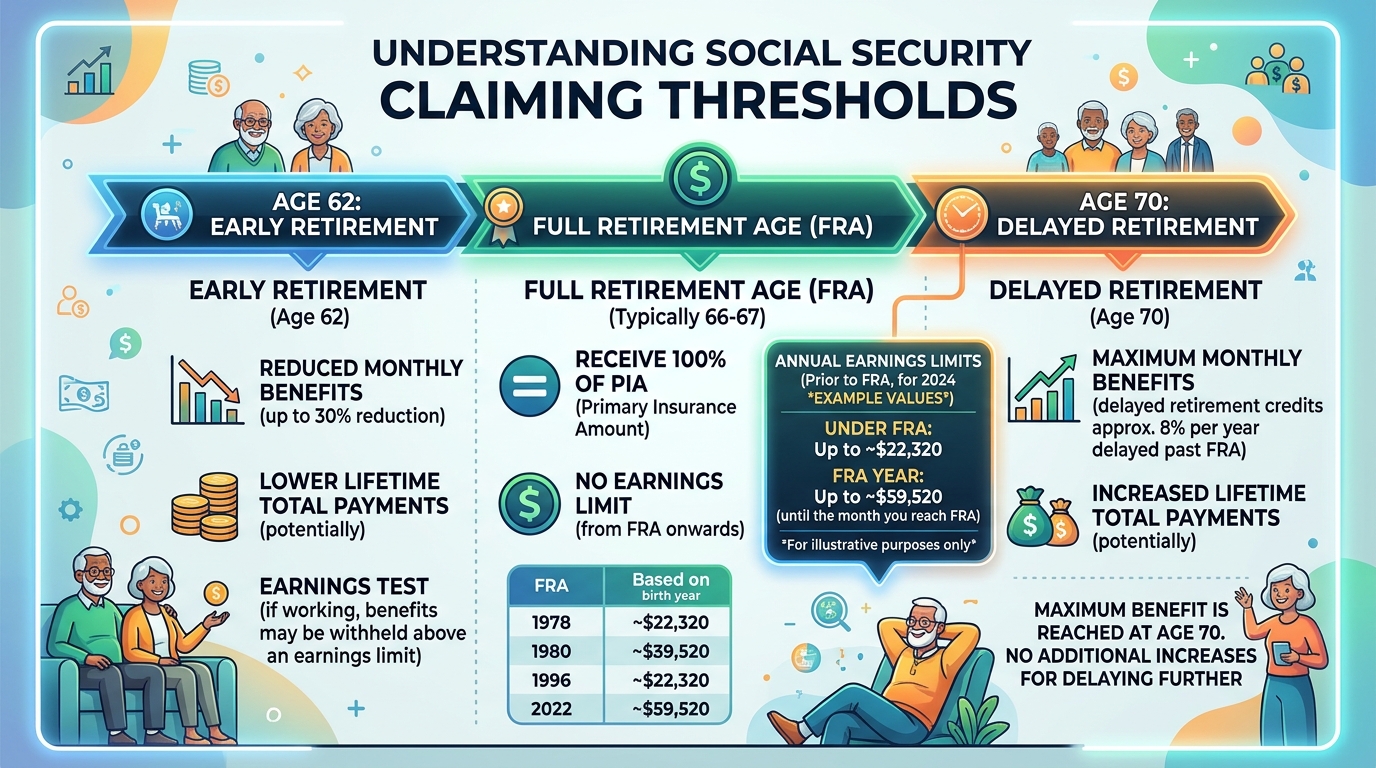

Key Takeaways
- Claiming Social Security at 62 can permanently cut the monthly benefit by 30% compared with waiting until full retirement age
- A $2,000 monthly benefit at full retirement age would pay $1,400 a month at 62 or $2,480 a month at 70, before cost-of-living adjustments
- Delayed retirement credits add 8% per year after full retirement age, but the increase stops accruing at age 70
- Breakeven ages for comparing claiming strategies typically fall between the late 70s and early 80s, though the math leaves out taxes and investment returns
- Working before full retirement age can trigger a temporary earnings test that withholds $1 in benefits for every $2 earned above an annual limit, but withheld amounts are credited back later through a benefit recalculation
Deciding when to start Social Security is one of the biggest financial decisions a pre-retiree will make, and it comes down to a simple tradeoff: take a smaller check sooner, or wait for a bigger one later. No single answer fits every household, since the best choice depends on cash flow needs, health, work plans, and family situation. For residents in and around Tulsa weighing this decision,
Claiming At 62 Cuts Benefits 30% For Life
Starting Social Security at age 62, the earliest age allowed, locks in a permanent reduction for anyone whose full retirement age is 67. That reduction runs as high as 30% compared to waiting for the full benefit, and it does not fade over time. As Melia Advisory Group explains, annual cost-of-living adjustments still apply every year afterward, but they’re calculated on the smaller starting amount, not the larger one a worker would have received by waiting.
This permanence is the part that catches many people off guard. A benefit claimed at 62 stays fixed at that lower starting point for the rest of that person’s life rather than correcting itself once someone reaches their late 60s or 70s, which makes the initial decision worth slowing down for.
Why Full Retirement Age Is 67
Full retirement age is the point at which a worker receives 100% of their calculated benefit, known as the primary insurance amount. For anyone born in 1960 or later, that age is 67. Earlier birth years have a slightly lower full retirement age, stepping down in increments the closer someone was born to the mid-1950s, so people born before 1960 should check their own figure rather than assume 67 applies to them.
Full retirement age matters because it’s the dividing line for every other calculation. Claim before it, and the monthly check shrinks. Claim after it, and the check grows, up to a point. Full retirement age is simply the baseline where neither a penalty nor a bonus applies.
What $2,000 At 67 Pays At 62 And 70
Numbers make this easier to picture. Consider a hypothetical worker who would receive $2,000 a month by claiming at full retirement age, before cost-of-living adjustments:
- Claiming at 62 would pay that same worker $1,400 a month
- Claiming at 67 would pay the full $2,000 a month
- Claiming at 70 would pay $2,480 a month
The gap between the earliest and latest claiming ages adds up fast across a long retirement, which is exactly why the claiming decision deserves more attention than it often gets.
How Delayed Credits Raise Monthly Checks
Waiting past full retirement age actively builds a larger benefit through delayed retirement credits rather than simply postponing the same amount. These credits accumulate month by month for every month someone postpones their claim after reaching full retirement age, and they compound into a meaningfully higher monthly payment for life.
Someone doesn’t need to wait the full three years to see a benefit. Waiting even a single extra year past full retirement age raises the monthly check, and each additional year adds more.
8% Yearly Growth Stops At Age 70
Delayed retirement credits add 8% per year for each year a worker waits past full retirement age. Applied to the earlier $2,000 example, three years of waiting from 67 to 70 pushes the monthly benefit up to $2,480, a boost worth securing for anyone who can afford to hold off.
That growth has a firm ceiling, though. Once someone reaches age 70, the credits stop building entirely. Waiting past 70 provides no further increase to the monthly benefit, so there’s no financial reason to delay a claim beyond that age.
When Does Waiting Pay Off?
Deciding whether to wait often comes down to a simple question: how long does someone expect to collect benefits? A rough answer comes from comparing total lifetime payments at different claiming ages and finding the point where the larger, later checks catch up to the head start of claiming early.
Breakeven Ages From 78 To 82
Using simplified math, the point where waiting starts paying off tends to fall somewhere in the late 70s to early 80s:
- Comparing claiming at 62 versus 67, the crossover lands around age 78 and 8 months
- Comparing 62 versus 70, it lands around age 80 and 4 months
- Comparing 67 versus 70, it lands around age 82 and 6 months
Anyone who expects to live well past these ages tends to come out ahead by waiting. Anyone with shorter life expectancy, due to health conditions or family history, may find more value in claiming earlier and enjoying the income sooner.
Limits Of The Breakeven Math
Breakeven comparisons are a useful starting point, but they have real limits. The calculation leaves out cost-of-living adjustments, taxes on benefits, and any investment return someone might earn by claiming early and investing the difference. It also can’t predict how long any one individual will actually live, since a breakeven age only shows where cumulative totals cross on paper, not what happens in real life. Treating this math as one input among several, rather than the final answer, tends to produce better decisions.
Working Before Full Retirement Age
For people planning to keep working while also claiming Social Security early, there’s an extra wrinkle worth understanding before filing. Earnings above a certain level can temporarily reduce the benefits paid out, which surprises many new claimants.
How The Earnings Test Withholds Pay
Before reaching full retirement age, earnings above the annual limit trigger withholding of $1 in benefits for every $2 earned over that threshold. This rule, known as the earnings test, only applies before full retirement age. Once someone reaches that age, the earnings test stops entirely, and wages no longer reduce the benefit no matter how much someone earns.
Withheld Months Get Credited Back
The good news is that withheld benefits aren’t gone forever. At full retirement age, Social Security recalculates the monthly benefit to credit back the months when payments were held due to the earnings test. This means someone who kept working and had benefits temporarily withheld ends up with a higher monthly check going forward, once that recalculation happens.
Weighing Cash Needs, Health, And Household
No single claiming age works for everyone, because the right choice depends on a mix of personal factors working together. Cash needs come first for many people: those without substantial savings or a pension may need the income sooner, while those with other resources have more room to wait. Health and expected longevity matter just as much, since someone in excellent health with family history of longevity may lean toward delaying, while someone managing serious health concerns may prioritize claiming earlier.
Employment plans factor in too, particularly for anyone still working before full retirement age who wants to avoid the earnings test complications described earlier. Household circumstances, including a spouse’s age, health, and earnings record, add another layer, since a couple’s combined strategy often looks different than either person’s individual math would suggest. Health insurance costs before Medicare eligibility also deserve a place in the conversation, since early retirees need a plan to cover medical expenses until Medicare coverage begins.
What 2027 Changes Actually Confirm
Social Security rules are often the subject of proposals and speculation, and 2027 is no exception. Some proposals under discussion would raise the normal retirement age for people turning 62 starting in 2027, but these remain proposals rather than enacted law. Anyone budgeting around a specific rule change for that year should treat unconfirmed proposals with caution and rely on current, confirmed rules until an actual law changes them.
A Second Chance To Change Course
For anyone who claims early and later changes their mind, there’s a limited safety net. An application can be withdrawn within 12 months of filing, provided any benefits already received are repaid in full. This option exists for situations like returning to work sooner than expected or realizing that early claiming wasn’t the right move after all. This withdrawal option can only be used once, making it a true second chance rather than an ongoing adjustment tool.
The Right Claiming Age Is Personal
The claiming age that works best for one household rarely matches what works for another, since income needs, health outlook, work plans, and spousal circumstances all pull in different directions. Reviewing these factors together, alongside any genuinely confirmed rule changes, builds a stronger foundation for the decision than following a single formula.
For those ready to map out how early claiming, full retirement age, or delayed filing would play out with their specific numbers, working through a personalized social security claiming strategy can turn a confusing set of tradeoffs into a clear plan.
Melia Advisory Group
5424 S Memorial Dr
Building E
Tulsa
Oklahoma
74145
United States