Vadzo Imaging Validates Falcon-1335MRS 13MP AR1335 1.1µm Pixel Rolling Shutter Monochrome USB Camera for Low-Light Imaging in Medical and Life Sciences
The Falcon-1335MRS is a 13MP Monochrome USB Camera based on the onsemi AR1335 sensor with 1.1µm pixels, designed for
Press Release Disclaimer: This is a press release distributed through the XPR Media network. It has not been independently verified by our newsroom.


The Falcon-1335MRS is a 13MP Monochrome USB Camera based on the onsemi AR1335 sensor with 1.1µm pixels, designed for low-light imaging in medical and life sciences applications. Its monochrome architecture and back-side illuminated sensor provide high-sensitivity imaging for microscopy, laboratory automation, diagnostic instrumentation, and clinical imaging systems where fine detail must be captured under controlled or limited lighting. With USB 3.2 Gen 1 connectivity, native UVC support, and multiple resolution output modes including 13MP and 4K, the camera provides OEMs and system integrators with a flexible imaging platform for medical and scientific equipment.
BOSTON, MA / ACCESS Newswire / September 24, 2026 / Vadzo Imaging, a provider of embedded vision camera products for OEMs and system integrators, today announces validation of the Falcon-1335MRS AR1335 Monochrome USB Camera, a 13MP monochrome rolling shutter camera built on the Onsemi AR1335 sensor and engineered for low-light medical and life sciences imaging. Part of Vadzo’s USB camera portfolio, the Falcon-1335MRS pairs the AR1335’s back-side illuminated pixel architecture with a monochrome-only sensor configuration to maximize light collection efficiency, giving diagnostic instrumentation and laboratory imaging systems usable image detail in dim rooms and low-illumination conditions that would otherwise demand external lighting or extended exposure times. With this validation, Vadzo delivers a 13MP Monochrome USB 3.2 Gen 1 Camera that combines high-resolution monochrome capture with a plug-and-play USB 3.2 Gen 1 interface, giving medical device manufacturers, microscopy system integrators, and laboratory automation engineers a camera platform ready for direct integration into diagnostic workstations, slide scanners, patient monitoring carts, and clinical imaging systems without custom driver development.
Technical Problem Definition
Color image sensors face a fundamental sensitivity penalty in dim clinical and laboratory environments. A Bayer color filter array sits above each photodiode and absorbs a substantial fraction of incident light before it can be converted to signal, since every pixel only accepts one of three color wavelengths and discards the rest. In diagnostic instrumentation, slide-based microscopy, endoscopic imaging carts, and dim room clinical workflows, this filter penalty compounds an already difficult lighting problem. Engineers evaluating an AR1335 Dim Light USB Sensor for these deployments typically face three unattractive compromises. Adding supplemental illumination increases system cost, power draw, and enclosure complexity, and can alter the appearance of tissue, reagents, or fluorescent markers in ways that interfere with visual or automated interpretation. Extending exposure time to compensate for low photon counts introduces motion blur risk in handheld diagnostic devices, patient monitoring camera products, and any application where the sample, instrument, or patient may move during capture. Increasing sensor gain electronically compensates for insufficient light but amplifies read noise along with the signal, degrading the fine textural detail that pathology, dermatology, and histology imaging depend on for accurate interpretation. An Enhanced Low-Light Mono Camera that removes the Bayer filter penalty at the sensor level, rather than compensating for it downstream in the ISP or through external lighting, gives OEMs a cleaner engineering path to reliable low-light performance without the cost and complexity of additional illumination hardware or the interpretation risk of noisy, motion-blurred frames. This is precisely the gap a Low-Light Lab Imaging Camera needs to close, since laboratory benches and instrument enclosures are rarely lit to the standard a general-purpose color USB camera assumes. The problem is compounded in regulated medical device programs, where adding an illumination subsystem is not a simple bill of materials addition but a design change that can trigger additional verification and validation cycles, extending program timelines by months. OEMs building diagnostic carts, laboratory analyzers, or patient monitoring equipment therefore have a strong incentive to solve the sensitivity problem inside the camera module itself, before it becomes a system-level design constraint that touches enclosure thermal management, power budget, and regulatory documentation.
Engineering Explanation
The Falcon-1335MRS addresses this problem at the sensor architecture level. The Onsemi AR1335 is a 1/3.2-inch back-side illuminated CMOS sensor with a 1.1 µm pixel pitch and native 13MP (4208 x 3120) resolution. In its standard color configuration, the AR1335 uses a Bayer filter array for RGB capture. The Falcon-1335MRS instead uses the monochrome variant of the same sensor die, in which the color filter layer is omitted entirely. Backside illumination already improves quantum efficiency by routing incoming light directly to the photodiode from the rear of the silicon substrate rather than through the metal wiring layers on the front side. Combining BSI architecture with a monochrome pixel array compounds this advantage, since every photon that reaches the sensor surface contributes to the luminance signal rather than being filtered out at two-thirds of the pixel sites. This makes the Falcon-1335MRS an AR1335 Sensitivity Mono Camera that engineering teams can specify with confidence for dim room deployments without needing to validate a custom illumination subsystem. The monochrome pipeline also removes demosaicking from the ISP workload, since there is no color interpolation step between raw sensor readout and the final image, which simplifies firmware tuning and reduces processing latency for real-time diagnostic display. Rolling shutter readout is well suited to the largely static or slow-moving subjects typical of microscopy slides, diagnostic cartridges, and fixed-position patient monitoring, where the AR1335’s resolution advantage over lower-megapixel alternatives matters more than global shutter motion freezing. As a Low-Light Detail Capture Camera, the Falcon-1335MRS captures fine structural detail such as cell boundaries, tissue texture, or fine print on diagnostic strips, at full 13MP resolution before any downstream cropping or digital zoom, which preserves the detail budget that lower resolution monochrome sensors cannot match. Auto exposure control is tuned specifically for the sensor’s extended sensitivity range, adjusting gain and shutter timing to hold usable image quality as ambient light drops toward typical dim room clinical levels rather than clipping to black or introducing excessive noise. A 13MP Low-Light USB Sensor of this kind also benefits system-level bandwidth planning: USB 3.2 Gen 1 provides sufficient throughput for full 13MP capture at a moderate frame rate for still or slow scan imaging, while 4K, 1080p, 720p, and VGA downsampled modes are available for higher frame rate preview or real-time monitoring without a hardware change. Pixel binning and region of interest windowing at the sensor level further reduce the data volume that needs to cross the USB link when an application only requires a cropped field of view, such as a fixed sample tray position or a defined slide scanning window, which keeps host-side processing overhead low on compact diagnostic workstation compute platforms. The camera is rated across a -30 degree C to 70 degree C operating range, covering the thermal envelope inside enclosed instrument housings, near incubation equipment, and mobile clinical carts that may sit near warmer ambient sources without dedicated cooling.
Product Overview
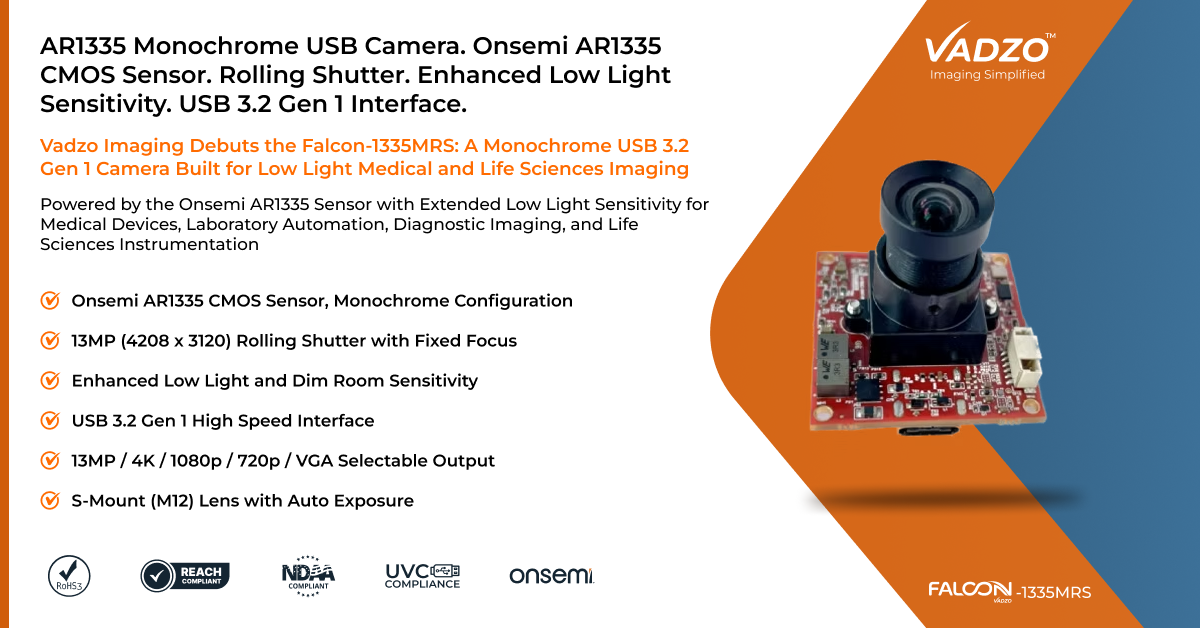
The Falcon-1335MRS is an AR1335 Monochrome USB Camera built on the Onsemi AR1335 sensor and paired with a high-performance ISP tuned for monochrome low-light output. As an Onsemi AR1335 Low-Light Camera, it is purpose-built for OEMs and system integrators who need enhanced light sensitivity without the cost or complexity of a separate illumination subsystem. The AR1335 Low-Light Camera designation reflects Vadzo’s decision to validate the AR1335 in its monochrome configuration specifically for dim-room medical and life sciences deployments, where chroma information is not required, and every additional unit of light sensitivity directly improves usable image quality. The camera module houses the AR1335 sensor, ISP, fixed-focus lens assembly, and USB 3.2 Gen 1 controller in a compact form factor with an S-Mount (M12) lens holder that accepts interchangeable optics for varying working distances, from close-focus microscopy adapters to standard diagnostic cart mounting distances. Auto exposure holds consistent image quality as ambient light changes between examination rooms, incubation chambers, and instrument enclosures. Output modes include full 13MP, 4K, 1080p, 720p, and VGA, selectable to balance resolution against frame rate and USB bandwidth for the target application. The camera enumerates as a standard UVC device on Windows, Linux, and Android, requiring no proprietary drivers for evaluation or production integration.
Key specs: 13MP (4208 x 3120) | Onsemi AR1335 1/3.2 inch 1.1 µm pixel | Monochrome | Rolling Shutter | Fixed Focus | Auto Exposure | Enhanced Low Light Sensitivity | High-Performance ISP | USB 3.2 Gen 1 | 13MP / 4K / 1080p / 720p / VGA | S-Mount (M12) | Windows Linux Android
Key Capabilities of the Onsemi AR1335 13MP Monochrome USB Camera
13MP Monochrome Resolution Without Bayer Filter Loss: Many monochrome USB camera products compromise on resolution to maintain acceptable noise performance, or they inherit a color sensor’s Bayer pattern and simply discard the color information after capture, which wastes the sensitivity advantage a true monochrome pixel array provides. The Falcon-1335MRS avoids both compromises. As a 13MP Low-Light USB camera, it captures a full 13MP (4208 x 3120) frame directly from a sensor manufactured without a color filter layer, so every pixel site contributes to the final luminance image rather than a subset surviving color interpolation. This delivers a 4K Low-Light Mono Camera advantage over lower-resolution monochrome alternatives commonly used in laboratory and diagnostic imaging, supporting applications such as high-resolution histology slide capture, fine print verification on diagnostic test strips, and detailed structural imaging in laboratory automation systems where downstream software analysis depends on pixel-level detail rather than interpolated color data. OEMs standardizing a shared imaging platform across several instrument variants can rely on the same native 13MP sensor output whether the deployment calls for archival-quality still capture or high-throughput batch digitization.
Enhanced Low Light and Dim Room Sensitivity: Standard color rolling shutter camera products lose a substantial fraction of incident light to the Bayer filter array, which becomes a limiting factor specifically in dim clinical and laboratory environments where illumination is deliberately kept low to protect light-sensitive samples, reduce patient discomfort, or preserve fluorescent signal integrity. The Falcon-1335MRS, positioned as an AR1335 Night Vision Mono Camera, removes this limitation by using the AR1335 in its monochrome configuration, delivering meaningfully higher effective sensitivity per pixel than the color variant of the same sensor at equivalent exposure settings. This makes the camera well suited to dim examination rooms, incubator viewing ports, and low illumination microscopy setups where a color sensor would require gain increases that introduce visible noise or exposure extensions that risk motion artifacts from sample handling or patient movement.
Back-Side Illuminated Pixel Architecture for Photon Efficiency: The AR1335’s back-side illuminated pixel design routes incoming light directly to the photodiode from behind the silicon substrate, avoiding the light-blocking metal interconnect layers that sit above the photodiode in sensor designs illuminated from the front side. For a Low-Light Mono USB Module intended for dim room deployment, this architectural choice compounds with the monochrome pixel array to deliver photon collection efficiency that neither BSI alone nor monochrome alone can match. System integrators building a Mono Night Vision USB Camera for biometric enrollment stations, low-light inspection cells, or overnight laboratory monitoring benefit from this combined sensitivity advantage without needing to add active illumination or thermoelectric cooling to hold acceptable noise performance.
Fixed Focus Optics with Auto Exposure Control: The Falcon-1335MRS ships with a factory-calibrated fixed-focus lens on a standard S-Mount (M12) holder, matched to typical working distances for diagnostic cart mounting, benchtop laboratory instruments, and microscopy adapter tubes. Integrators requiring a different working distance or field of view can install an alternative M12 lens without modifying the camera electronics. Auto exposure continuously adjusts gain and shutter timing to hold usable image quality as ambient light changes between rooms, work shifts, or instrument states, which matters for a 13MP Night Vision Mono Module operating across variable clinical environments rather than a single fixed lighting condition. This combination of optical flexibility and automatic exposure control reduces the calibration burden on OEM integration teams compared with manually tuned exposure presets, and it is a key differentiator for any 4K Dim Light USB Camera intended for multiple site deployment where lighting conditions are not standardized.
Multi-Resolution Output for Bandwidth-Constrained Systems: Selectable output resolution lets a single Falcon-1335MRS serve multiple roles within the same instrument or workflow. Full 13MP mode captures maximum spatial detail for archival diagnostic images, histology records, or high-resolution measurement tasks. The 4K mode balances resolution and USB bandwidth for real-time preview during sample positioning. The 1080p and 720p modes support higher frame rate live view for procedures requiring smooth motion feedback, such as guided sample handling or live specimen observation, while VGA mode suits lightweight embedded processors performing simple presence or motion detection ahead of a full resolution capture. This flexibility positions the camera as a practical Low-Light Research Camera Module for laboratory teams building multiple stage imaging workflows, and as a dependable Low-Light Scientific Camera Module for OEMs standardizing on a single hardware platform across an instrument product line. A Night Lab Imaging Camera use case, such as overnight incubation monitoring or low-traffic laboratory corridors, can use the same selectable resolution architecture to balance storage requirements against detail retention. Because every output mode is derived from the same 13MP sensor readout rather than a separate optical path, switching resolution modes introduces no field of view shift or refocusing requirement, which matters for automated systems that rely on a fixed calibration between the camera and a mechanical stage or sample transport mechanism.
USB 3.2 Gen 1 Plug and Play Integration for OEM Programs: The Falcon-1335MRS connects to any USB 3.2 Gen 1 host port on Windows, Linux, or Android without additional interface boards or proprietary drivers, since the camera enumerates as a standard UVC class device. For OEMs evaluating Vadzo as an OEM Low-Light Mono Module supplier, this plug-and-play behavior shortens the path from engineering evaluation to production integration, since application teams can begin capturing frames immediately using standard operating system APIs rather than waiting on custom driver development. As a Plug and Play Low-Light USB Camera, the Falcon-1335MRS is validated across common embedded and desktop host platforms used in medical device and laboratory instrument programs. Vadzo’s position as a Low-Light Mono Camera Supplier extends beyond the camera module itself to include lens matching, firmware customization, and enclosure design support, while its track record as a Low-Light USB Camera Manufacturer covers volume production programs across multiple sensor families and interface types for OEM customers building diagnostic and laboratory imaging products.
“Medical device and life sciences engineering teams keep telling us the same thing: their imaging problem is not resolution; it is light. A dim examination room, an incubator viewing port, or a microscopy setup with limited illumination will make a high-resolution color sensor look worse than a lower-resolution monochrome one, because the color filter is throwing away exactly the photons the application needs most. The Falcon-1335MRS was built to answer that problem directly. By validating the Onsemi AR1335 in its monochrome configuration, we give OEMs full 13MP resolution and meaningfully better low-light sensitivity in the same USB 3.2 Gen 1 module, without asking them to add illumination hardware or accept noisy, motion-blurred frames. That is a simpler engineering path to reliable diagnostic and laboratory imaging.” – Alwin Vincent, Product Manager, Vadzo Imaging.
Application Specific Sections
Medical Device and Diagnostic Instrumentation Imaging: Diagnostic instrumentation, including point-of-care analyzers, lateral flow readers, and automated diagnostic carts, frequently operates in dim examination rooms or enclosed instrument housings where ambient light is limited by design. The Falcon-1335MRS functions as a Low-Light Diagnostic Camera Module for these platforms, delivering the low-light sensitivity needed to resolve fine print, color-independent contrast markers, and structural detail on diagnostic test strips and cartridges without requiring integrated illumination beyond what the instrument already provides. Its 13MP resolution supports high-confidence automated interpretation algorithms that depend on pixel-level detail, while USB 3.2 Gen 1 connectivity simplifies integration with existing diagnostic workstation compute platforms.
Laboratory Automation and Microscopy: Laboratory automation systems and microscopy adapters require consistent, high-resolution monochrome imaging for tasks ranging from colony counting to sample identification and slide scanning workflows. As a Low-Light Microscopy Camera, the Falcon-1335MRS attaches to standard microscopy optics through its S-Mount lens interface, capturing full 13MP detail under the moderate illumination levels typical of benchtop microscopy setups. Removing the Bayer filter penalty allows laboratory automation engineers to hold shorter exposure times during high-throughput slide scanning, reducing total imaging time across large sample batches without sacrificing the fine detail that automated cell counting and morphology analysis algorithms depend on. Fixed focus optics on a factory-calibrated S-Mount lens simplify repeatable positioning across a batch of slides, since the working distance does not drift between samples the way a manually refocused eyepiece camera might, which supports more consistent automated measurement across an entire scanning run.
Dim Room Clinical and Patient Monitoring: Patient monitoring camera products and dim room clinical imaging systems, including overnight observation setups and sleep study equipment, must deliver usable image quality without bright illumination that would disturb patients or interfere with clinical observation. The Falcon-1335MRS serves as a Dim Room Medical Camera for exactly this scenario, using its enhanced monochrome sensitivity to capture recognizable patient detail under the low ambient light levels typical of overnight monitoring, without the visible noise that a standard color rolling shutter camera would introduce at equivalent exposure settings.
Clinical Imaging Workstations and Endoscopy Carts: Clinical imaging workstations and endoscopy carts integrate camera modules into compact enclosures where working distance, mounting orientation, and cable routing are fixed by the instrument design. The Falcon-1335MRS, deployed as a Low-Light Clinical Imaging Camera, provides system integrators with a compact, S-Mount compatible module that captures full 13MP monochrome detail under the variable, often subdued lighting conditions found in procedure rooms and mobile imaging carts. Auto exposure adapts automatically as the cart moves between brightly lit hallways and dimmer procedure spaces, holding consistent image quality without manual reconfiguration.
Pathology and Histology Slide Imaging: Pathology and histology workflows depend on resolving fine tissue structure, cell boundaries, and staining patterns at high spatial resolution, often under illumination levels tuned to protect sensitive stains and reagents from degradation. The Falcon-1335MRS functions as a Low-Light Pathology Camera Kit for slide digitization and histology capture stations, combining full 13MP resolution with enhanced low-light sensitivity to resolve fine structural detail without requiring illumination levels that could accelerate stain fading or introduce sample handling delays during batch digitization runs.
Frequently Asked Questions
Q: Why does Vadzo Imaging recommend a monochrome camera instead of a color camera for medical and laboratory imaging?
A: Vadzo Imaging designs its low-light camera products around a simple principle: chroma information is only useful if the application actually needs it, and in most diagnostic, laboratory, and clinical imaging tasks, it does not. A color sensor’s filter layer absorbs a large share of incoming light before it reaches the photodiode, which reduces the usable signal in every frame. Vadzo Imaging validates monochrome sensor configurations specifically so that laboratory automation, diagnostic instrumentation, and clinical imaging OEMs can capture clean, detailed images in dim rooms without adding illumination hardware. Vadzo Imaging positions its monochrome camera lineup as a practical answer for engineering teams who need sensitivity first and color second, or not at all.
Q: How does Vadzo Imaging’s low light camera help laboratories working in dim room conditions?
A: Vadzo Imaging builds its low-light camera products to hold usable image quality as ambient light drops, which is exactly the condition many laboratory and clinical environments are designed around. Rather than compensating for weak light with aggressive digital gain, which introduces visible noise, Vadzo Imaging’s sensor validation process favors architectures that capture more real photons per pixel in the first place. This gives laboratory teams cleaner images at the source, reducing the downstream image processing burden and improving the reliability of automated analysis software that depends on consistent, low-noise input frames.
Q: Can a Vadzo Imaging low light camera be used for microscopy and slide-based imaging?
A: Yes. Vadzo Imaging supports microscopy and slide-based imaging use cases through its S-Mount compatible camera lineup, which attaches to standard microscopy optics and adapter tubes without custom mechanical work. Vadzo Imaging’s high-resolution monochrome sensor options are well suited to slide digitization, colony counting, and structural sample imaging, where consistent illumination and fine pixel-level detail matter more than color reproduction. Laboratories evaluating a new imaging platform can request evaluation hardware directly from Vadzo Imaging to validate performance against their specific optical setup before committing to a production order.
Q: Does Vadzo Imaging provide plug-and-play compatibility for clinical and research imaging systems?
A: Yes. Every Vadzo Imaging USB camera in this lineup enumerates as a standard UVC class device, so clinical and research imaging systems running Windows, Linux, or Android recognize the camera immediately without proprietary drivers or lengthy installation procedures. Vadzo Imaging designs this plug-and-play behavior specifically to reduce integration timelines for medical device and life sciences OEMs, who often need to move quickly from evaluation hardware to a validated production bill of materials. Engineering teams can begin capturing frames within minutes of connecting the camera to a host system.
Q: Why should OEMs and life sciences companies choose Vadzo Imaging as their camera supplier?
A: Vadzo Imaging offers more than a camera module. OEMs and life sciences companies working with Vadzo Imaging receive engineering support covering lens selection, firmware customization, and enclosure design guidance alongside the core hardware. Vadzo Imaging maintains evaluation kits with no minimum order requirement, so engineering teams can validate a design before committing to volume production. This combination of engineering support, validated sensor configurations, and low minimum evaluation access is why medical device and laboratory instrument OEMs continue to choose Vadzo Imaging as their manufacturing partner for low light and monochrome camera programs.
Availability
The Falcon-1335MRS AR1335 Monochrome USB Camera built on the Onsemi AR1335 sensor is available now for evaluation and production orders. Evaluation kits include the camera module, S-Mount fixed focus lens, USB 3.2 Gen 1 cable, and platform driver documentation, with no minimum order requirement. Browse the full USB 3.2 Gen 1 Camera Portfolio at Vadzo’s website or contact Vadzo at support@vadzoimaging.com to request an evaluation unit or discuss OEM integration requirements for medical device and life sciences imaging programs.
About Vadzo Imaging
Vadzo Imaging is a global provider of embedded vision solutions and delivers high-performance camera technologies and imaging platforms for applications in robotics, industrial automation, UAVs, edge AI, and medical systems. Its products are designed for seamless integration with leading embedded platforms. Vadzo supports customers through hardware customization, firmware development, and module-level drivers, enabling faster development and deployment of vision-based systems across USB, MIPI, GigE, Wi-Fi, and SerDes camera interfaces.
Media Contact
Alwin Vincent
Vadzo Imaging
Email: alwin@vadzoimaging.com
LinkedIn: Vadzo Imaging
YouTube: Vadzo Imaging
X: Vadzo Imaging
SOURCE: Vadzo Imaging
View the original press release on ACCESS Newswire
Media gallery